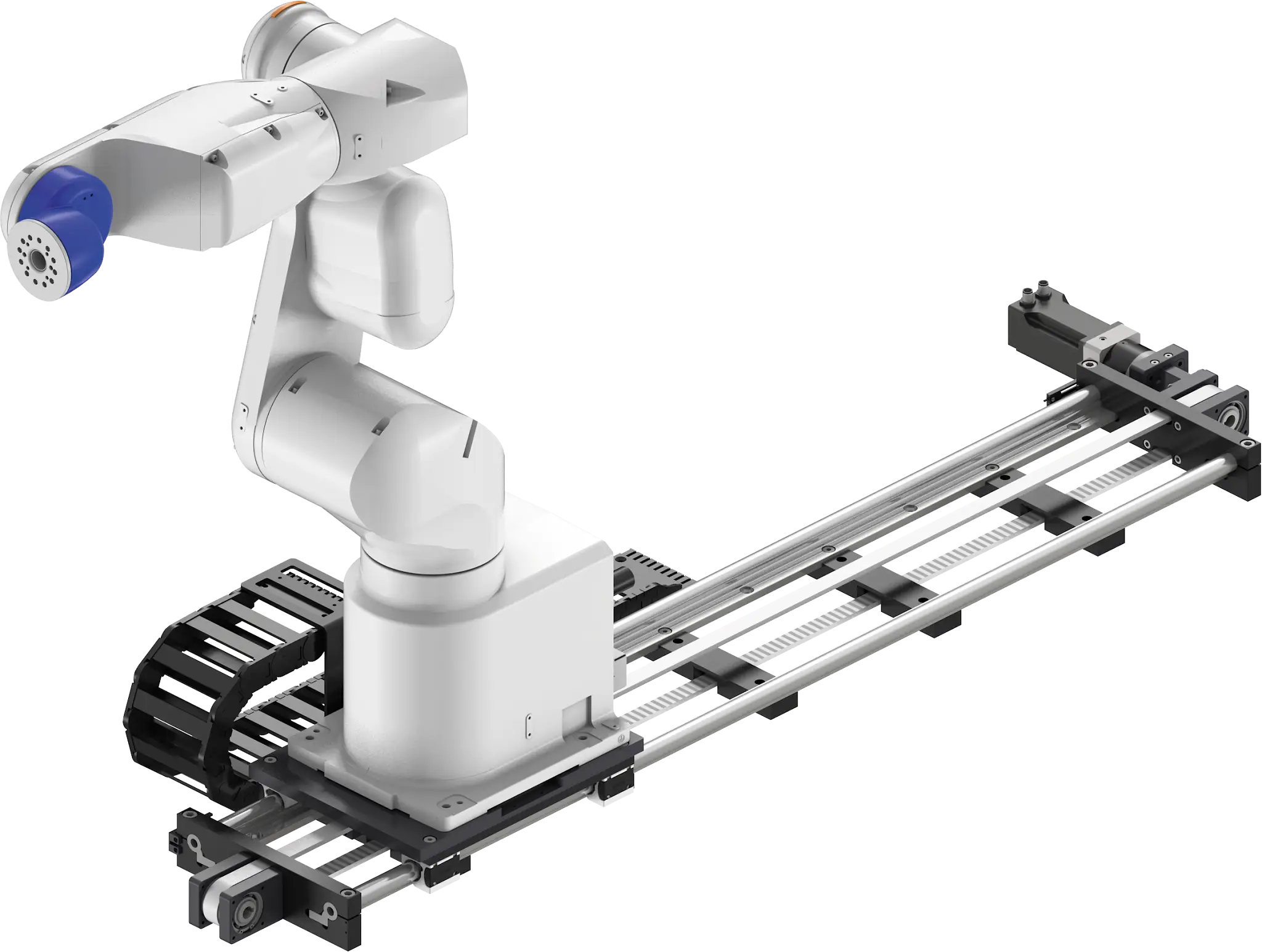
7th axis for Epson robots Our 7th axis is individual and versatile. It extends the range of action of Epson robots by up to 6000mm (according to technical design), making them much more flexible in applications. The drylin ZLW-20200 toothed belt axis is perfectly suited as a wide low-profile linear axis. An adapter kit is available for this axis for direct connection with the software of Epson robots. The ZLW-20200 toothed belt axis can be delivered as a ready-to-connect version with the matching adapter kit or the adapter kit can be supplied separately. The linear axis can be used for applications with a precision requirement of 0.3mm and a load of up to 55kg. This type of accessory has a max. speed of 0.3m/s. The axis is available with or without a control system. To control the axis in the Epson software, the control cabinet integration is required (see matching products). Our 7th axis consists largely of our tribologically optimised plastics and allows for significant cost savings. This is combined with a long service life and freedom from maintenance.
- Flexible use of robots instead of rigid kinematics
- Connection via linear carriage of the ZLW-20200 toothed belt axis
- Stroke lengths up to 3,000mm as standard, up to 6,000mm on request
- Adapter for e-chain system
- The ZLW-20200 toothed belt axis can be delivered ready to connect with the matching adapter kit.
- Control via software (no inverse kinematics)
- Robot kinematics: Epson T3, T6, VT6
Application examplesTypical applications of our 7th axes include pick & place applications, welding applications and much more.
7th axis control system for an easy way to get started with automationThe Epson unit makes robot control and programming easy and paves the way for automation. Direct control cabinet integration with Epson robots provides a simple and ready-to-connect solution. As a result, the 7th axis in the Epson software can be moved within a very short time. The solution is currently possible with the following Epson robots: T3, T6, VT6. A master control system is not necessary.
You can also use your own (robot) control system, that's no problem either.
Alternatively, you can operate each axis individually with a control system, e.g. with our igus® D1 dryve motor control system. This control system architecture requires one motor control system per linear axis or motor and an additional master control system that controls the coordination of the movement.
The motor control systems are not part of the product and can be ordered from us as an option. igus does not offer a master control system at the moment.